
back to overview

Why Players Stop Trusting the Dice

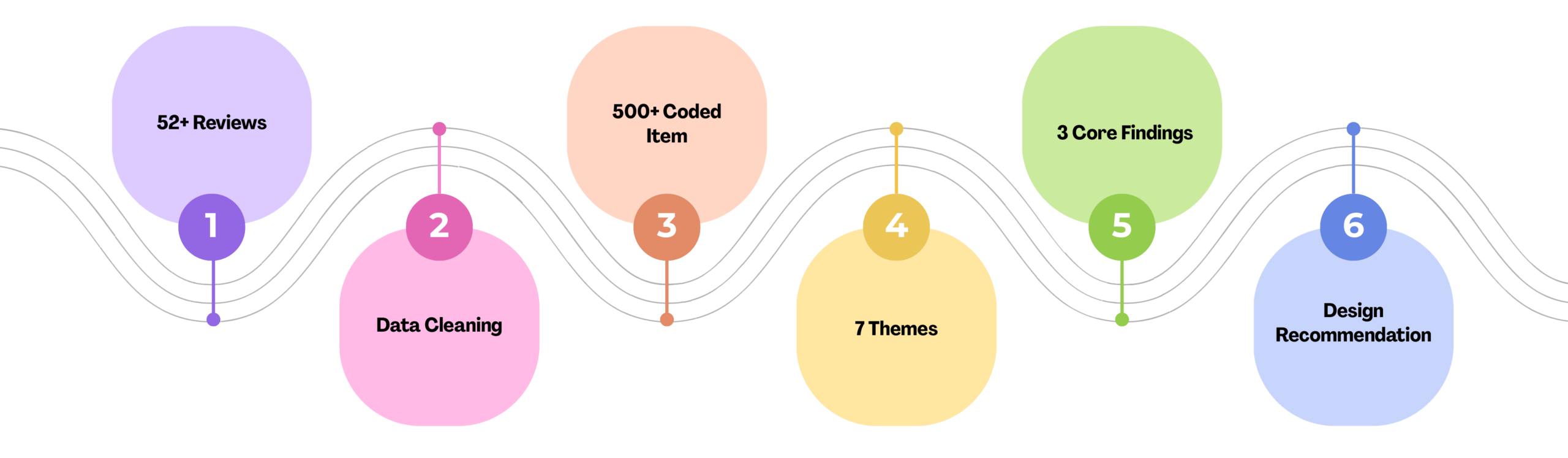
One of the projects I enjoyed most was analyzing player trust for a popular Persian-language backgammon platform. I processed five years of 52,000+ player reviews, support conversations, and community feedback to understand why players often believe a fair system is working against them. By examining how people interpret losing streaks and explain negative outcomes, I uncovered recurring patterns in trust, perception, and player behavior. The project highlighted how communication and user perception can influence trust just as strongly as the product itself.

UX Research | Mobile Gaming | Qualitative + Longitudinal | 2026
— The Problem

I wanted to understand why players continued to believe the game was manipulated even when no technical evidence supported those claims. As player complaints became increasingly emotional and repetitive, it became clear that the issue was not simply about game mechanics or probability. My goal was to investigate how perceptions of unfairness emerge, evolve, and spread among players over time.

— The Scope

To explore this question, I conducted a longitudinal qualitative study of more than 52,000 player reviews collected over 5 years, alongside archived customer support conversations. The research focused on identifying recurring themes, emotional patterns, and trust-related narratives that shaped players’ interpretations of wins, losses, and randomness within a competitive online backgammon environment.

— Tools & Process

I analyzed Google Play, local app marketplace reviews, and customer support archives using a combination of Claude AI, Notion, and Miro. Claude supported large-scale qualitative analysis and theme detection, while Notion was used for research documentation and coding. Miro helped synthesize findings through affinity mapping and insight clustering.

— Methodology

I conducted an inductive thematic analysis of player reviews and support conversations, combining qualitative coding with affinity mapping to identify recurring patterns. The study was informed by research on trust, fairness perception, cognitive biases, mental models, and player behavior, focusing on how users interpret randomness, build explanations for negative outcomes, and develop long-term beliefs about the system.

I used Inductive Thematic Analysis (ITA), meaning I let the themes emerge from the data rather than testing a pre-existing theory. Each year’s reviews were coded independently before comparing across years, which revealed how the language of complaint evolved, not just the volume.

— Findings

What players actually said?

All quotes below are translated from Persian app store reviews of the players, not prompted, writing what they genuinely believed.

Bot Suspicion

“If you were honest, you’d let us chat with the opponent just to confirm we’re playing against a real person and not a bot.”

Pattern Recognition

“I’ve played backgammon for 20 years. I’ve never seen anything like this. Sometimes I can predict the exact dice roll that’s about to come.”

Bot Suspicion

“90% of games feel managed. They let you win a few to stop suspicion. Put in 50 gems and lose: gone. Win: you only get 30 back. Two wins equal one loss.”

Bot Suspicion

“No matter what, your win rate never passes 55% meaning the game forces a loss on you whether you want it or not.”

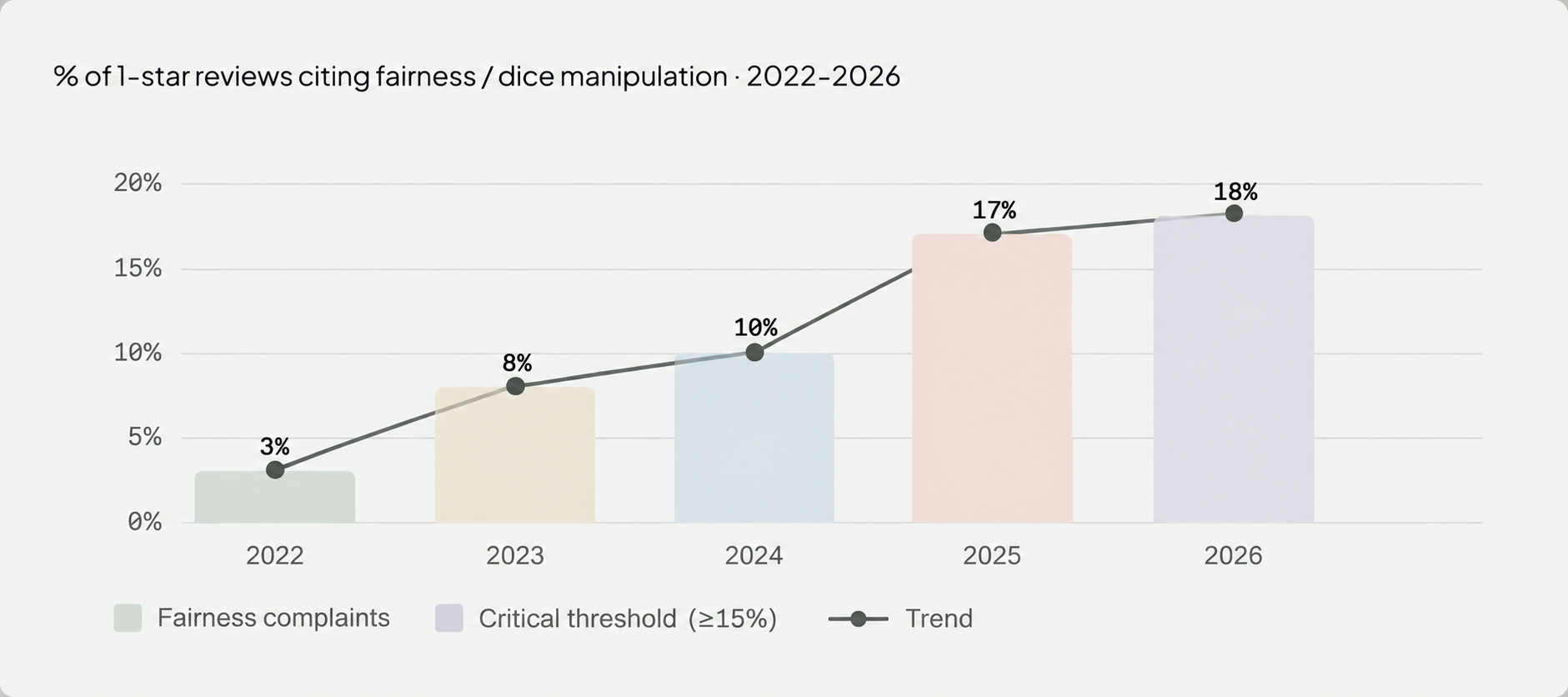
Fairness complaints grew ×6 in five years

— Takeaways

What I Found?

The research showed that players were not simply reacting to bad luck, they were responding to a breakdown of trust. In the absence of transparency, users created their own explanations for losses, often attributing intent and agency to the game system. The most powerful driver of dissatisfaction was not randomness itself, but the lack of information and reassurance around it.

What I Would Change?

Based on the findings, I would prioritize transparency over persuasion. Features such as dice history, probability explanations, clearer disconnection handling, human-opponent verification, and more empathetic support responses could help players understand outcomes without feeling dismissed. The goal is not to convince players that the system is fair, but to give them enough information to evaluate fairness for themselves.

What If There Were No Research Constraints?

With direct access to gameplay telemetry, player retention data, matchmaking records, and in-game behavior analytics, I would combine qualitative findings with quantitative evidence to map exactly how trust evolves over time. I would also run interviews, usability studies, and controlled experiments to test whether transparency features can reduce perceptions of manipulation and improve long-term player trust.

Full preprint available via DOI: 10.31235/osf.io/gzsr7_v1