
back to overview

Building Better Content Workflows with AI

Independent Project · Content Systems Design

Developed in 2026, this independent project explored how small product and EdTech teams can use AI while maintaining content quality, consistency, accessibility, and human oversight.

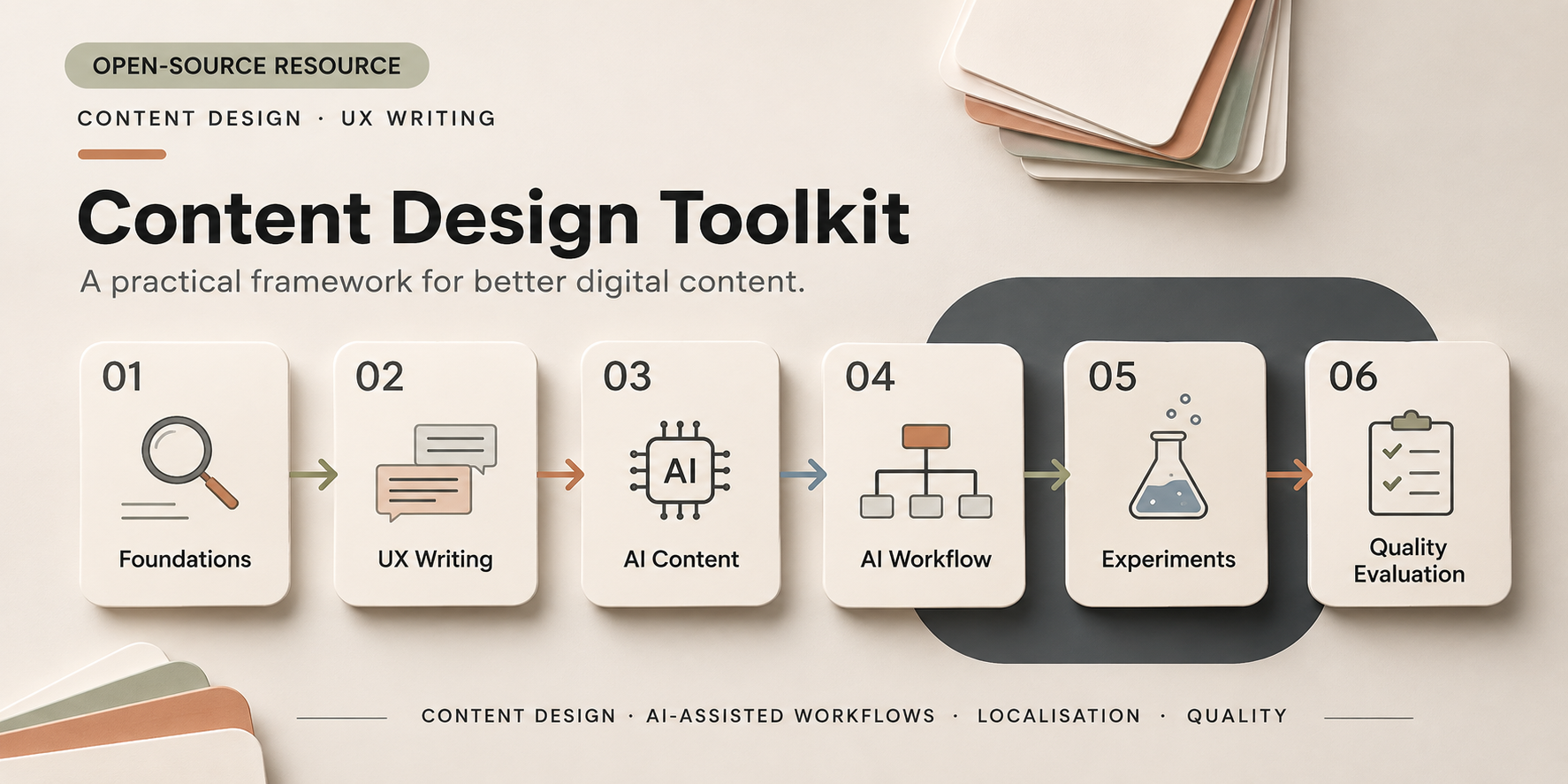
It brought together content design, UX writing, AI-assisted workflows, and quality evaluation, resulting in a six-stage workflow, human review checkpoints, and practical tools for assessing individual content and wider collections.

Content Design | AI-Assisted Workflows | Content Quality & Localisation

— The Problem

Small product and EdTech teams adopting AI-assisted content production need more than faster content generation. They need a structured way to maintain quality, consistency, accessibility, and localisation while keeping human reviewers accountable.


— The Scope

I built a practical framework covering content design, UX writing, technical documentation, and AI-assisted workflows, from content creation and review to localisation and quality evaluation. It includes workflow stages, human oversight checkpoints, templates, and evaluation methods for small teams.

— Tools & Process

Used Notion, GitBook, GitHub, Markdown documentation, and structured templates to develop, organise, and publish the framework. The process combined ChatGPT and Claude for AI-assisted content development and evaluation, with Miro for workflow mapping, Persona, alongside content design standards, human review, localisation workflows, and content audits to make quality checks practical and repeatable.

— Research Method

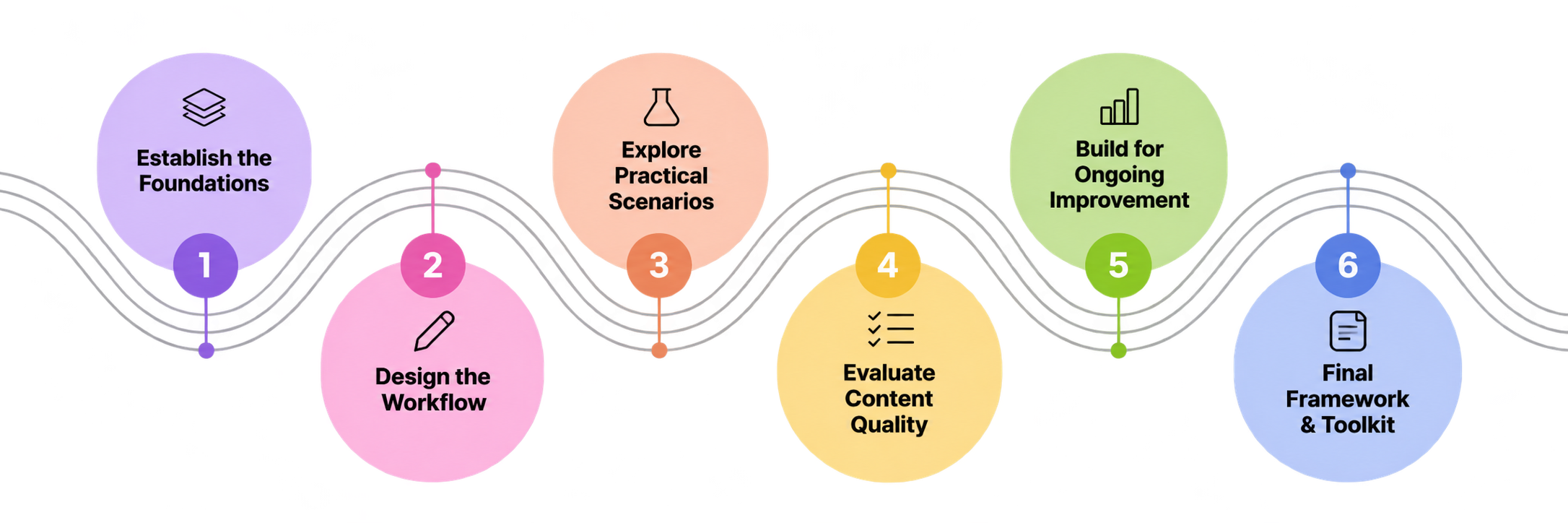
The project developed step by step, moving from content principles to a practical, testable workflow. I first established the foundations and UX writing standards, then developed guidance for AI-assisted content creation and a structured production workflow with human review and localisation steps. Next, I used five constructed scenarios to examine voice consistency, grounding, accessibility, localisation readiness, and human oversight. Finally, I translated the observations into a broader content quality framework, including evaluation methods, an issue classification system, and an approach to auditing existing content.


— Designing the Workflow

Developed a six-stage content lifecycle supported by five human oversight checkpoints. Each stage defines the work required, while checkpoints establish where human review and decisions take place.

The workflow also addresses localisation, revision routing, and different operating models for individual practitioners and small teams.

— Primary Persona

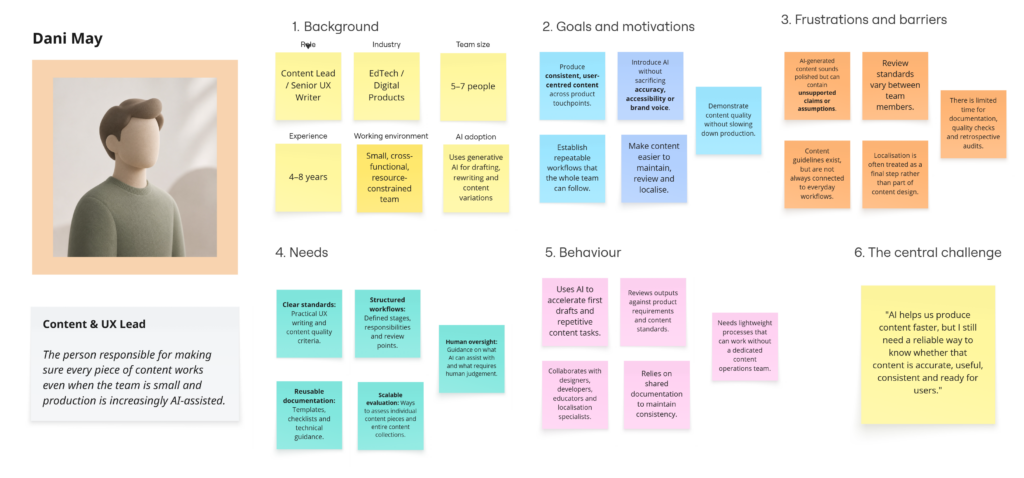
The Content Lead

The person responsible for making sure every piece of content works; even when the team is small and production is increasingly AI-assisted.

— User Journey

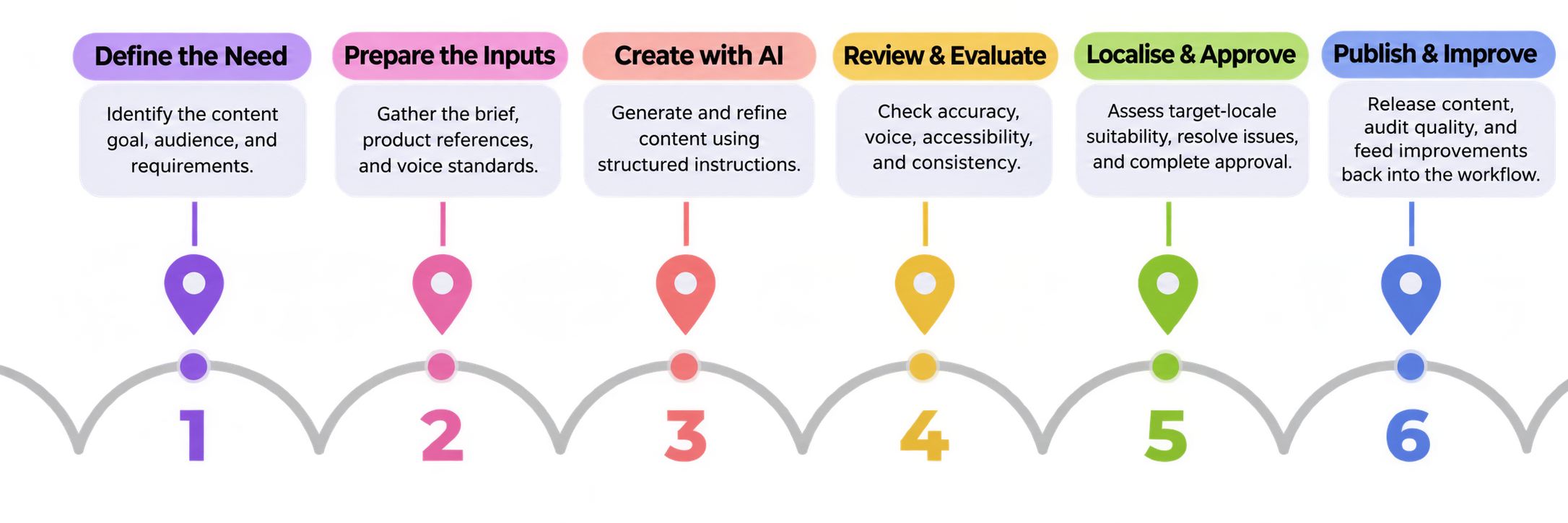
The journey shows how the Content Lead uses the framework to move from an initial content need to reviewed, approved, and maintainable content. It highlights where AI supports production, where human judgement is essential, and how quality continues beyond publication.

Journey stages

  1. Define the need: Identify the content goal, audience, requirements, and constraints.

  2. Prepare the inputs: Gather the brief, product references, voice standards, and relevant guidance.

  3. Create with AI: Generate and refine content using structured instructions and reference materials.

  4. Review and evaluate: Check accuracy, voice, accessibility, audience fit, and consistency through human oversight.

  5. Localise and approve: Assess target-locale suitability, resolve issues, and complete final approval.

  6. Publish and improve: Release content, audit quality, identify recurring issues, and feed improvements back into the workflow.

— Design Implications

The findings informed several design decisions for the framework, shifting the focus from simply improving AI-generated content to building a reliable, human-led content system.

  • Design for human oversight: AI supports production, but review and approval remain human responsibilities.

  • Make quality assessable: Provide explicit criteria, reference materials, and clear distinctions between what can and cannot be verified.

  • Integrate localisation early: Treat localisation as part of the content workflow, not a final translation step.

  • Evaluate beyond individual outputs: Assess consistency across content collections, not just the quality of individual pieces.

  • Connect issues to action: Classify quality problems and link them to appropriate review, revision, and remediation paths.

  • Support small teams: Use practical templates, clear documentation, and repeatable processes without requiring complex infrastructure.

Core design principle: Build a workflow where AI can accelerate content production without weakening human judgement, content quality, or accountability.

— Findings

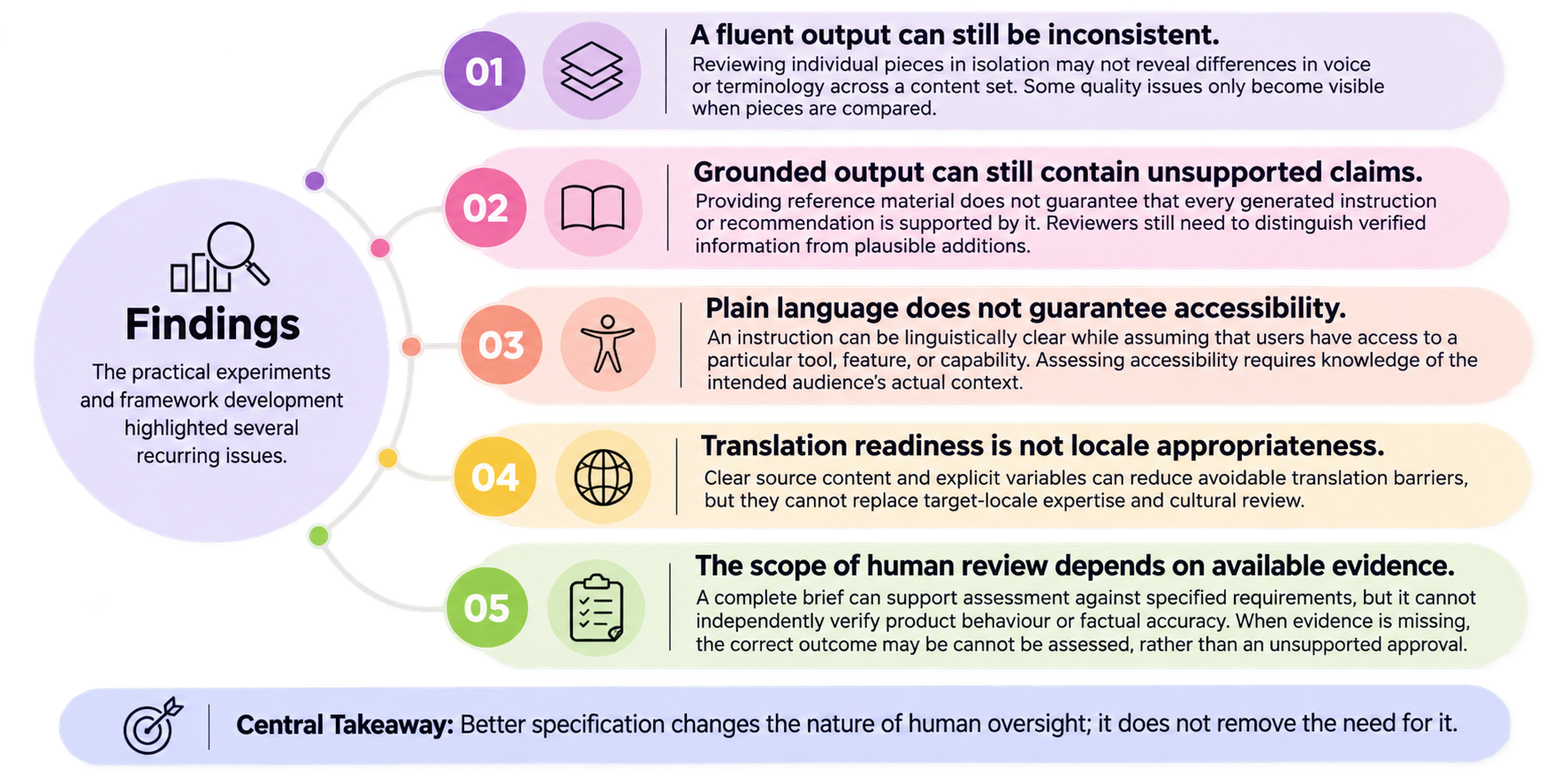
Better inputs do not eliminate the need for human judgement.

The five practical scenarios revealed three recurring insights about AI-assisted content production. Together, they showed that better AI output does not automatically mean better content: quality depends on the guidance, evidence, and human judgement surrounding it.

— Recommendations

Treat AI-assisted content as a managed process, not a generation task.

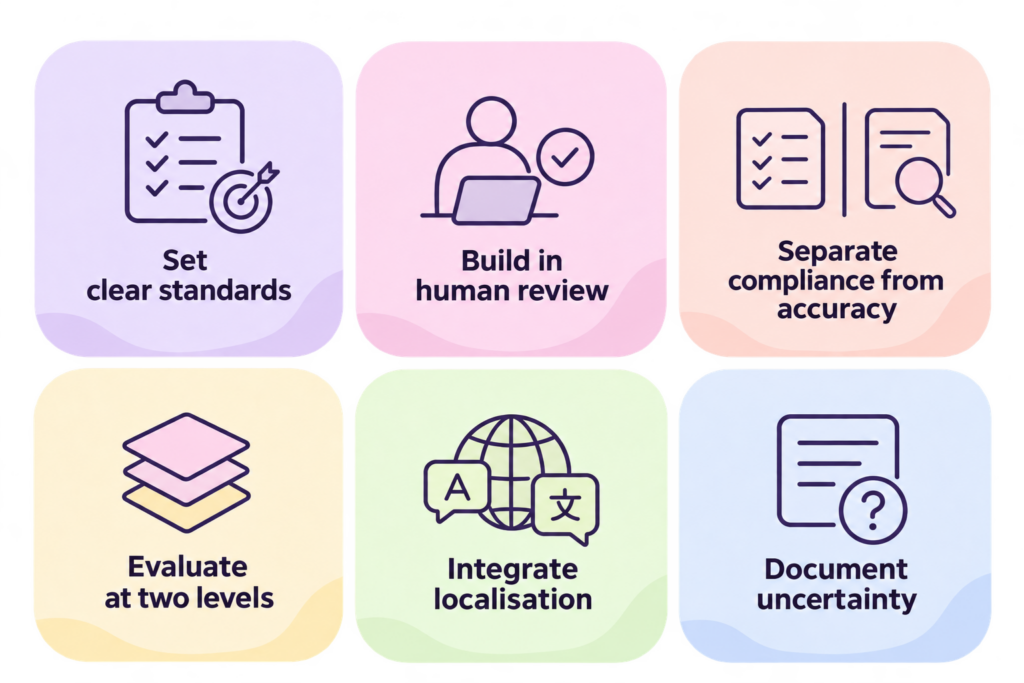
  • Set clear standards: Define voice, audience, terminology, and content requirements before production.

  • Build in human review: Establish clear review stages and accountability.

  • Separate compliance from accuracy: Check brief alignment and factual correctness independently.

  • Evaluate at two levels: Assess individual content quality and consistency across collections.

  • Integrate localisation: Require target-locale expertise and review before approval.

  • Document uncertainty: Record what cannot be assessed and what evidence is missing.

— Outcome

A practical framework for accountable AI-assisted content operations.

The project resulted in a modular content framework for small teams, combining standards, workflows, quality evaluation, and reusable documentation.

  • Content standards: Shared principles for user-centred content and UX writing.

  • AI workflow: Six lifecycle stages, five human oversight checkpoints, and localisation guidance.

  • Operating models: Practical guidance for individual practitioners and small teams.

  • Practical experiments: Five constructed scenarios exploring content quality and review limitations.

  • Quality evaluation: 13 dimensions covering individual content and collection-level quality.

  • Content auditing: Methods to assess existing content and prioritise improvements.

  • Reusable resources: Templates, evaluation records, and technical documentation.

The outcome is not an automated approval system, but a structured way to make AI-assisted content production more transparent, reviewable, and accountable.

Built to be forked, not just read.

All frameworks, templates, guidelines, and examples are available on GitHub under CC BY 4.0.

Explore the Documentation on GitBook