
back to overview

Localization & Content Management Framework

Independent Concept · Self-Initiated Project

An open-source framework for small EdTech teams to structure, validate, and localize educational content. CMF combines JSON Schema-based content architecture, cultural-readiness checklists, localization-aware validation, and a structured publishing workflow.

Version 2.0.0 extends the original framework with per-locale character limits, translation-state management, source-version tracking, and glossary consistency checks.

EdTech | Content Design | Localization | UX Research

Self-Initiated Project · Concept Development & Informal Testing · 2026

My Role

Content Designer & System Architect

Scope

7 languages · 4 types · 8 examples

Status

Open-source · CMF v2.0.0 · MIT License

— The Problem

Small teams build for one language, then discover they need seven.

EdTech teams expanding across Europe often find that content built for one language is costly to adapt later. Without a scalable content system, ad-hoc localization creates more than delays: it risks inconsistent guidance and eroding user trust.

No structure, full rewrites.
  • Content built without localization in mind requires expensive ground-up rewrites at every new market, not just translation.
Translations that miss the culture.
  •  Linguistically correct text with the wrong cultural register does more damage than a rough translation, so it signals the product was not built for this audience.
Developers as content gatekeepers.
  •  Without a content system, every change ”a label update, a corrected explanation, a translated phrase” requires developer involvement. Content teams lose ownership of their work.

This framework addresses the problem before production. Cultural decisions are made explicitly at the authoring stage, not discovered during a localization sprint six months later.

— Research Foundation

Grounded in real multilingual job-seeker needs

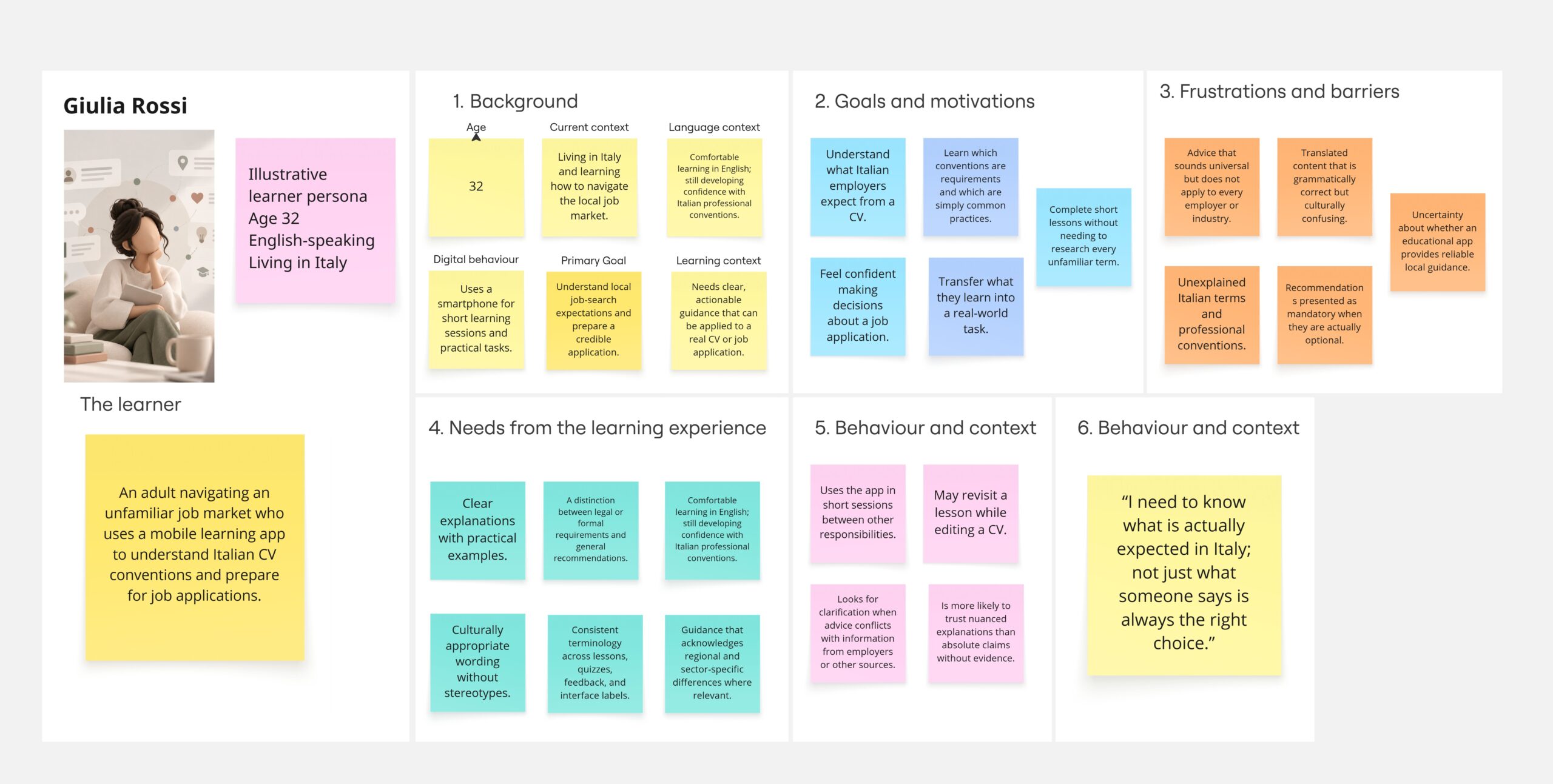
Designed for immigrants aged 25–40 learning Italian job-search skills, the framework addresses a specific context where language and cultural differences can create friction.

— Six learner personas · one per source language

Testing real questions “Should I include a photo on my Italian CV?” and “Is Europass always the right format?” revealed how prescriptive advice can mislead across cultural contexts. Through iterative reviews, the framework replaced absolute claims like “safe default” with accurate, context-sensitive guidance: “a reliable starting point, especially for those new to the Italian market.”

— Sample Persona

The six language lenses

Under the primary persona, create six smaller cards in Miro. These represent language contexts to consider during localization, not six stereotypical types of people.

en
English
Baseline source language
it
Italian
Grammatical gender, Lei/tu register
es / es-419
Spanish
Vosotros/ustedes, regional variation
fr / fr-CA
French
Tu/vous, France/Québec variation
de
German
Sie/du, D-A-CH regional variation
nl / nl-BE
Dutch
Je/u register, nl-NL vs nl-BE
sv
Swedish
Du-reformen, flat hierarchy norms

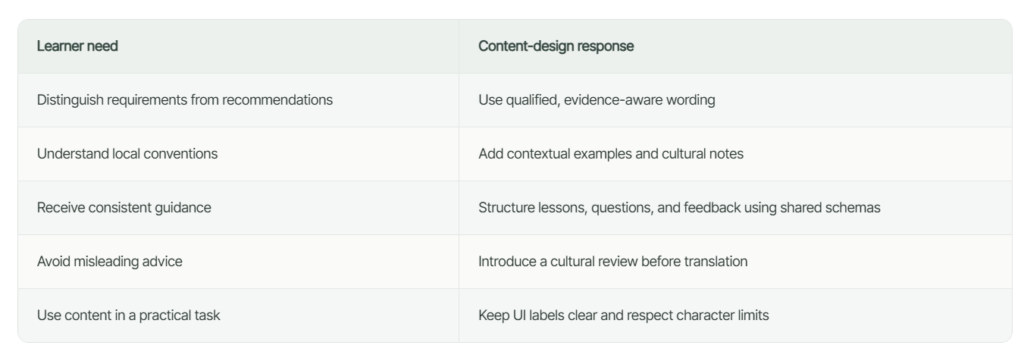
Design implications

— Tools & Process

Used Claude and GPT for drafting, Miro for mapping, Notion for documentation, and Figma for visual design. The result was a framework combining four content types, cultural-readiness checklists for seven languages, and a five-stage publishing workflow, refined through human review.

— The Framework

Three pillars → One coherent system

Each pillar solves a specific failure mode. Together they ensure that a small team can produce localized content that is structurally sound, culturally reviewed, and developer-independent.

Content Architecture

Without typed schemas, translators lack clear guidance and developers own every content decision.

I developed four JSON Schema content types supported by an AJV-based validator. Version 2.0 extends the schemas with translation lifecycle states, locale-specific constraints, source-version tracking, and metadata for managing localization decisions.

  • lesson — instructional units with body blocks, key terms, and locale-readiness tracking
  • question — quiz items with per-option metadata and correctness validation
  • feedback — correct/incorrect response messages with register and tone fields
  • ui-label — interface strings with maxLength, placeholder tracking, and formality

JSON Schema Draft-07 | AJV v8 strict | culturalReadinessScore | localizationFlags | sourceLanguage

Cultural Readiness Checklists

Linguistic accuracy alone doesn’t guarantee cultural trust. A two-layer checklist system reviews content before translation, catching cultural issues at source, where revisions cost less.

  • universal.md: Scenario dependency, idioms, cultural specificity, and scoring rationale.

  • /lang/xx.md: Language-specific grammar, register, regional variation, and localization traps.

  • Scoring: 0–10, with a minimum of 3 to enter cultural review and explicit reasoning for each criterion.

  • Review remains mandatory: Scores of 9–10 enable faster approval, not skipped review.

Examples: tu/Lei/Sie/vous · du-Reformen · gender agreement · D-A-CH variation

Cultural review is only one layer of localization readiness. Version 2.0 complements these checklists with technical validation, including per-locale character limits, text-expansion warnings, and glossary consistency checks.

Content Workflow

Content ownership shouldn’t require a developer ticket for every change.

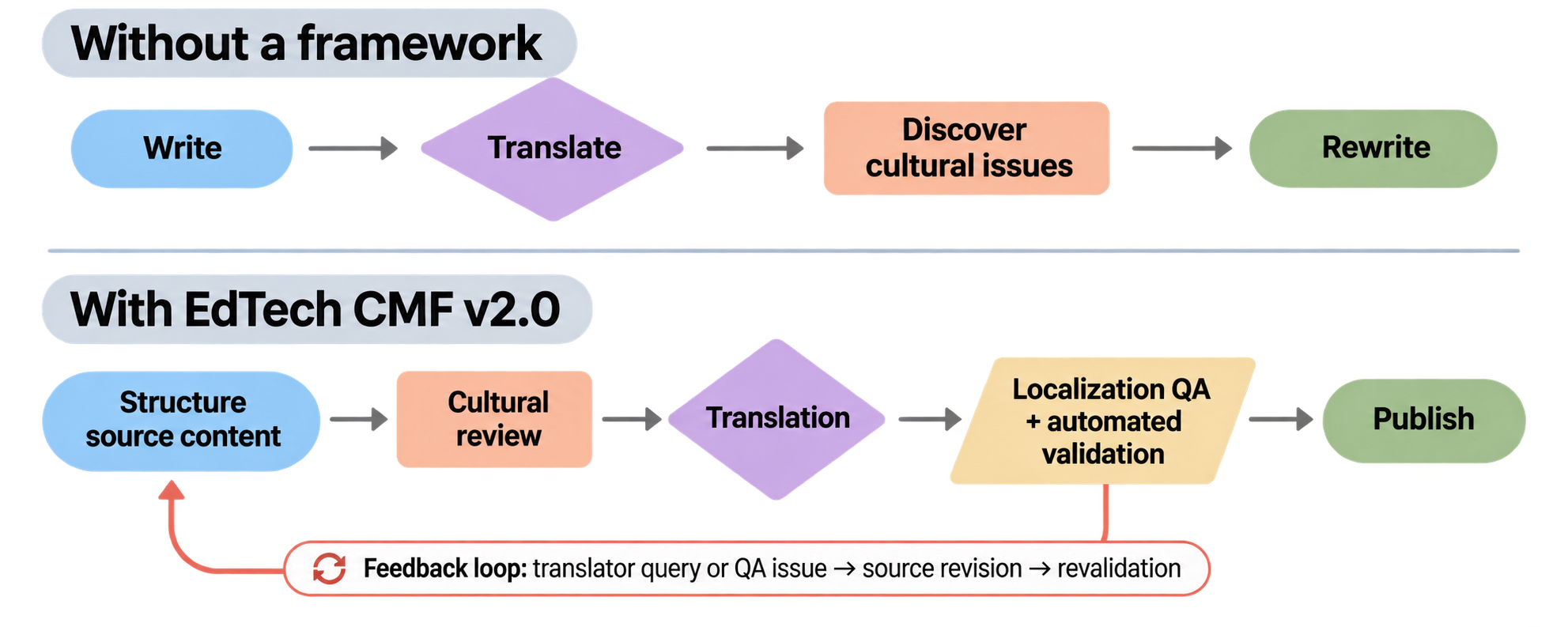
A five-stage workflow designed for teams of 5–7, with flexible roles and one rule: content authors cannot review their own work for cultural accuracy. Other roles can be combined, including reviewer and translator.

[row_inner_3] [col_inner_3 span__sm=”12″]

Translation Feedback Loop

Translator query → Source update → Revalidation

Version 2.0 allows translators to flag issues and request source-content revisions before publication.

[/col_inner_3] [/row_inner_3]
— VERSION 2.0.0

What’s new in v2.0

The first version established the content architecture and cultural review process. During further development, I identified technical gaps that cultural checklists alone could not address. Version 2.0 introduces additional validation mechanisms to handle these issues.

CMF v2.0 — Key Improvements

  • Localization: Locale-specific character limits and text-expansion warnings.
  • Translation workflow: Translator queries, translation-ready status, and source-version tracking.
  • Content validation: Glossary consistency, source-freeze controls, and ICU metadata.

ICU syntax validation is planned for a future release.

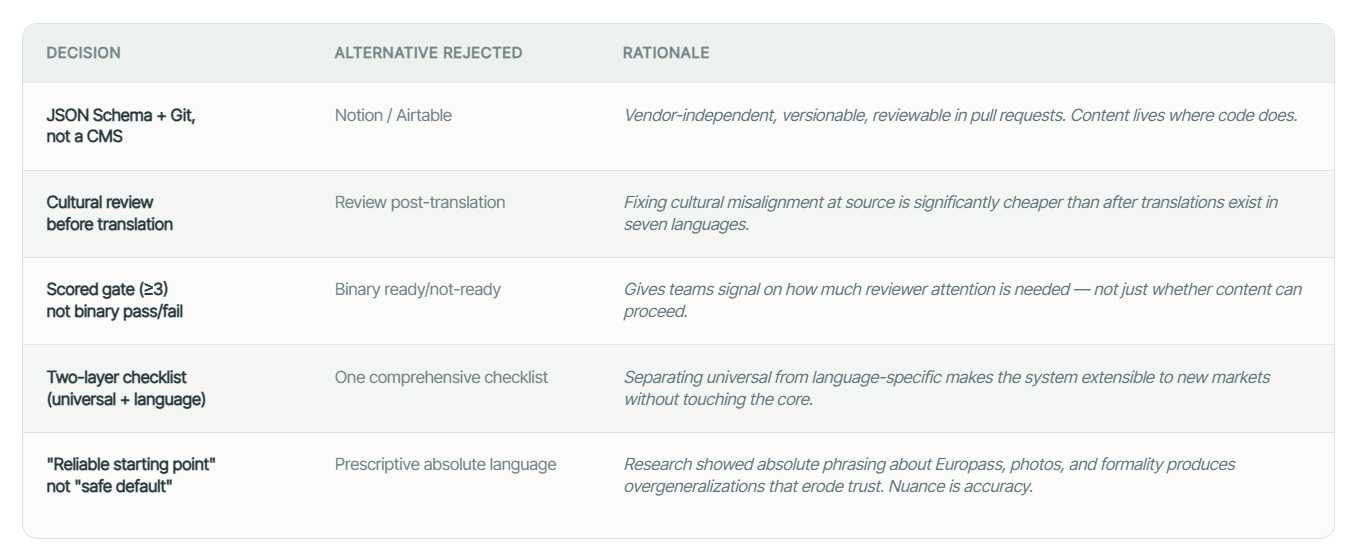
— Design Decisions

Why these choices, not the obvious ones

Each structural decision reflects a specific trade-off between simplicity and robustness. These were not defaults; they came from testing the system against real content.

— Worked Example

From English source to validated Italian translation

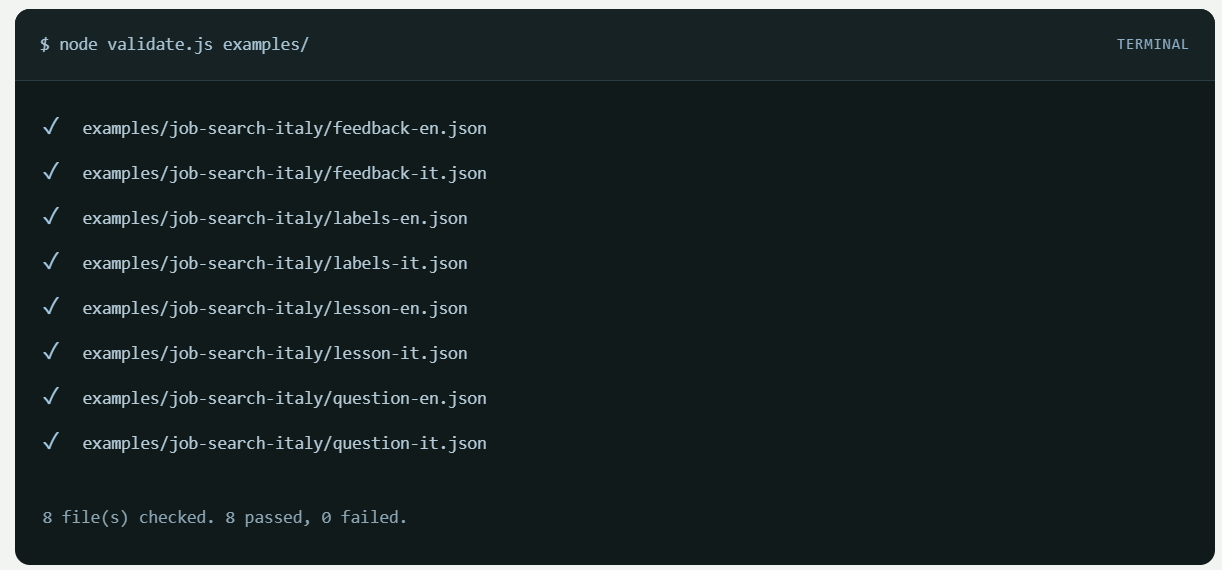
The examples/job-search-italy/ directory contains eight English and Italian example files covering lessons, questions, feedback, and UI labels.

The v2 validator combines JSON Schema validation with semantic checks for placeholders, quiz consistency, locale-readiness metadata, source-version mismatches, text expansion, and glossary consistency.

JSON Schema · AJV · Node.js · ICU metadata · Glossary validation

— Framework in Practice: Party Hub

From Framework to Product

Applying a localization framework to a live, cross-platform social gaming product.

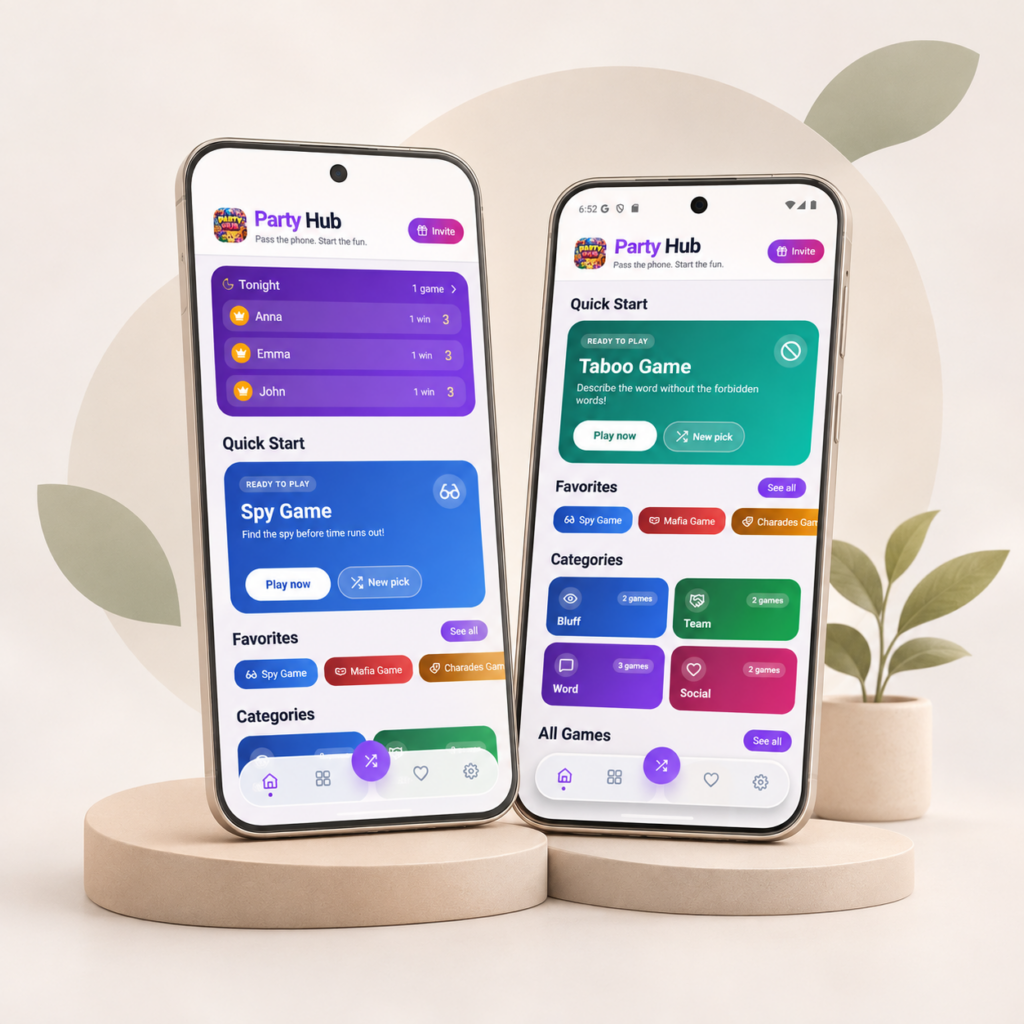
I collaborated with the developer of Party Hub, an offline mobile party game, to expand its language support from English and Persian to five languages: English, Persian, Italian, Arabic, and Spanish.

Beyond content translation, I applied my Content Management & Localization Framework to establish a structured localization workflow, combining multilingual content adaptation with systematic quality and consistency controls.

My Contributions

Localization Strategy & Workflow
 
  • Applied my localization framework to a real-world product environment.
  • Established a structured approach to multilingual string management and content organization.
  • Introduced locale-specific character limits and text-expansion considerations.
  • Developed terminology and consistency guidelines across languages.
  • Incorporated localization QA processes to identify language-specific and interface-related issues.
Multilingual UX & Content Adaptation
 
  • Adapted game content across five languages: English, Persian, Italian, Arabic, and Spanish.

  • Addressed linguistic, cultural, and grammatical differences across language contexts.

  • Worked with right-to-left language considerations for Persian and Arabic.

  • Considered interface readability and content fit across localized versions.

— Explore the Product

This collaboration demonstrates the practical application of a localization framework, connecting content architecture, multilingual UX, and quality assurance in a published digital product.

— Outcomes

A system, that a non-technical reviewer can use on day one

⚑ What I found hardest

The framework remains a design and technical prototype without empirical validation in a production environment. The cultural-readiness scoring threshold needs calibration with professional reviewers, and ICU MessageFormat validation remains a planned extension. Testing the framework with real EdTech teams and professional translators would be the next step.

→ What I’d change with a real team

The scoring gate (≥3) should be calibrated with actual reviewers against real content; the current threshold is a reasonable starting point, but real usage data would sharpen it. I’d also add a translator-specific field to capture adaptation decisions, not just review status.

↗ What this unlocks next

The framework is designed to be forked. Adding a new language requires writing one checklist and extending the BCP-47 validator, nothing in the core schemas changes. The real test is seeing it used by someone other than me.

Built to be forked, not just read.

All schemas, checklists, examples, and the validator are on GitHub under MIT license.

Full preprint available via DOI:soon