
back to overview

Investigating English-Default Interfaces

Academic Research · Master’s Thesis

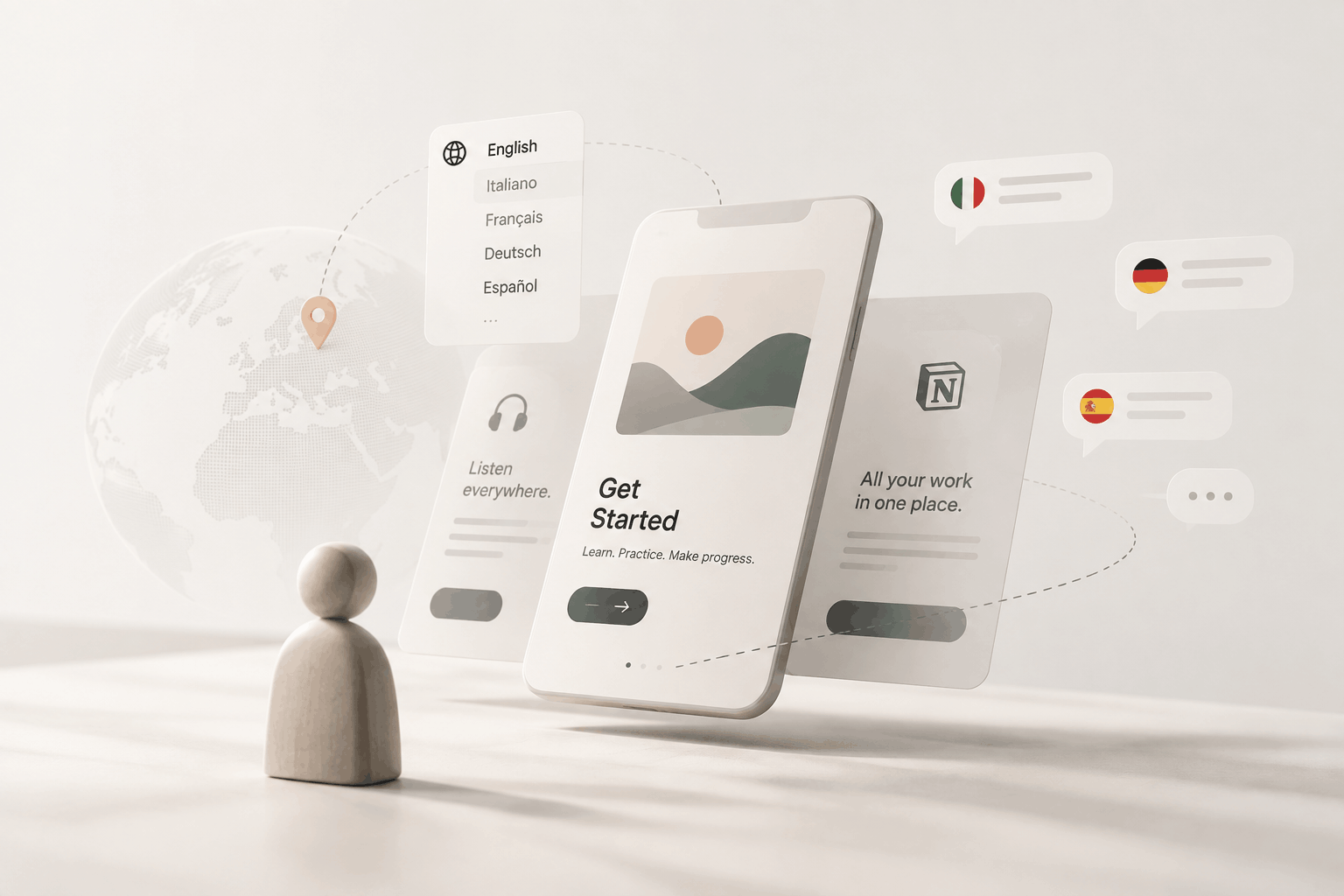
Conducted as part of my Master’s research in 2026, this study investigated how English-default interfaces shape the experience of users navigating digital products in a second language.

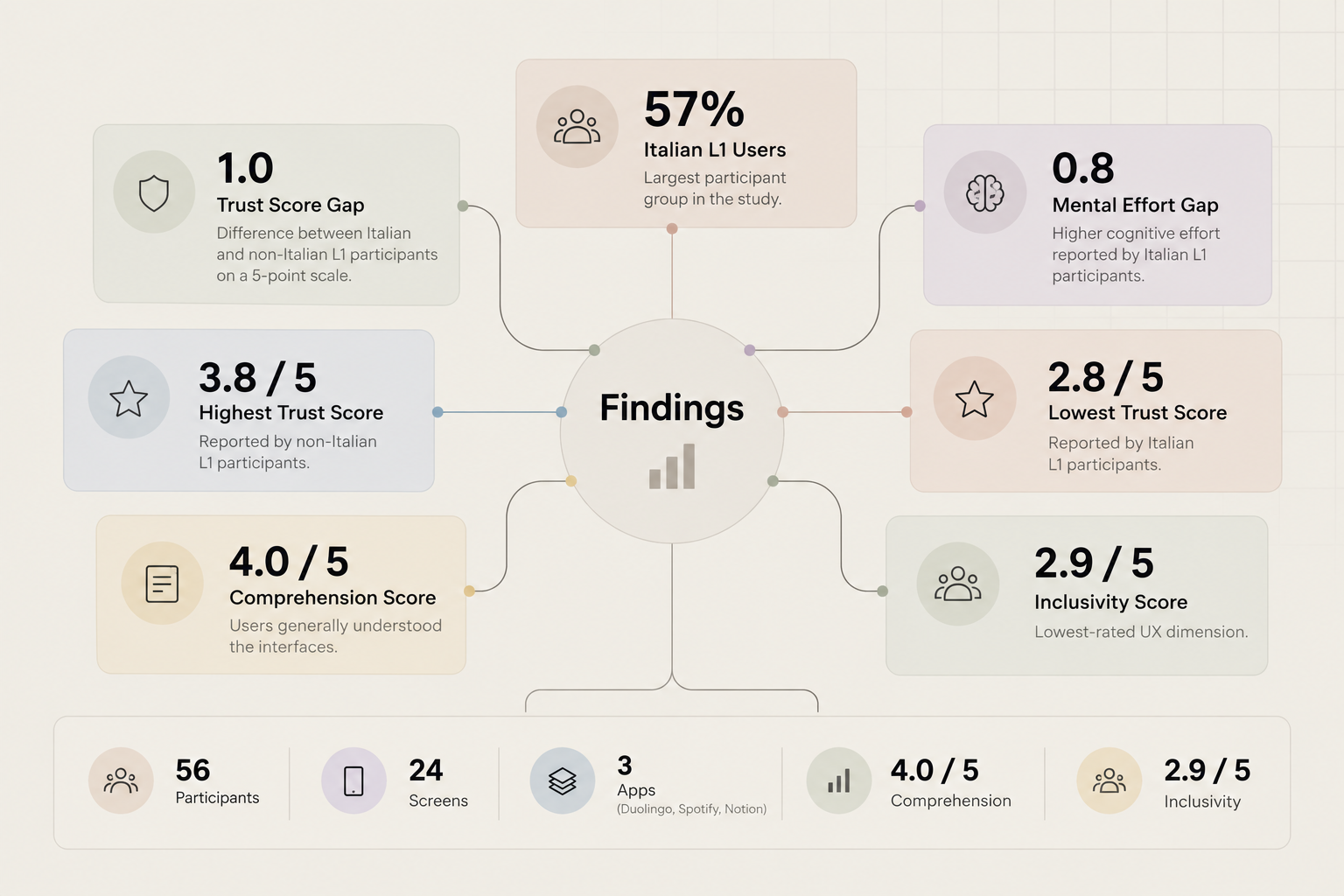
Analysing onboarding and upgrade flows across Duolingo, Spotify, and Notion, I combined multimodal interface analysis with survey responses from 56 participants to explore comprehension, mental effort, trust, and perceived inclusivity.

UX Research | Multilingual UX | Mixed Methods

Academic ·  2026 · UNINA

— The Problem

English-default onboarding and subscription flows can increase mental effort for users navigating a second language, affecting perceived clarity, trust, and inclusivity even when the content remains understandable.

— The Scope

Analysed 24 onboarding and upgrade screens across Duolingo, Spotify, and Notion, combining multimodal interface analysis with survey responses from 56 participants to examine comprehension, mental effort, trust, motivation, and inclusivity.

— Tools & Process

Used Notion and NotebookLM for project planning and literature review, Miro for thematic exploration, Google Forms and Sheets for survey data collection, SPSS for quantitative analysis, and Figma and Canva to annotate interfaces and communicate findings.

— Methodology

Interface Analysis
  • Examined 24 onboarding and upgrade screens from Duolingo, Spotify, and Notion.
  • Analyzed interface language and visual elements using a multimodal approach.
Survey Design
  • Collected responses from 56 participants using an online survey.

  • Explored perceptions of comprehension, mental effort, trust, motivation, and inclusivity.

Quantitative Analysis
  • Organized the survey data in Google Sheets.

  • Used SPSS to analyze quantitative results and compare reported experiences across participant groups.

Synthesis
  • Examined patterns across interface analysis and survey findings.

  • Identified opportunities to improve multilingual UX, language accessibility, and trust.

— Findings

— Key Research Insights

The research revealed three important dimensions of multilingual user experience, showing why interface comprehension, cognitive effort, and perceived trust and inclusion should be considered together.

01 — Comprehension

Understanding interface text does not necessarily mean understanding the full interaction or its implications.

02 — Cognitive Load

Dense interface language and complex upgrade flows can demand additional mental effort.

03 — Trust and Inclusion

Evaluating multilingual interfaces requires looking beyond language accuracy to users’ perceptions of trust and inclusivity.

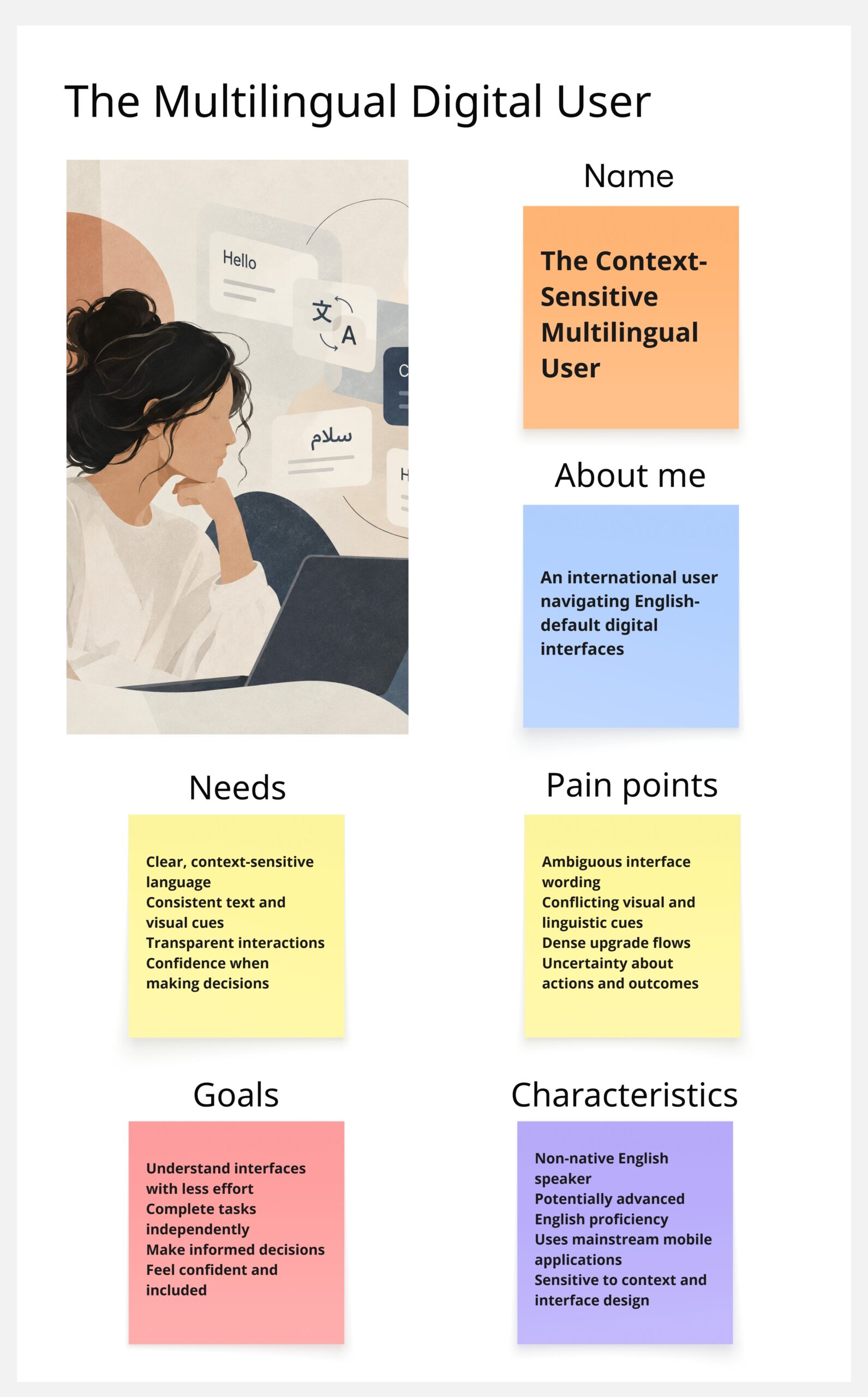
— Research-Informed UX Persona

Translated research findings into a user-centred persona exploring how language and interface design shape comprehension, trust, and inclusivity for users navigating digital products in a second language.

Research connection

The study found high comprehension but lower perceived inclusivity, showing why multilingual UX evaluation must go beyond language accuracy.

From Research to Design Implications

Interfaces can be understandable yet still create friction through ambiguous wording, inconsistent visual cues, and cognitively demanding interactions. Evaluating comprehension, trust, and inclusivity together helps identify opportunities for more accessible multilingual experiences.
 

What this means for UX design:

  • Language: Use clear, context-sensitive copy.

  • Visuals: Align visual cues with written instructions.

  • Interactions: Clarify actions, consequences, and upgrade flows.

  • Inclusion: Evaluate trust, confidence, and mental effort alongside comprehension.

— Takeaways

  • Comprehension isn’t enough: Users may understand an interface without feeling confident or included.

  • Language influences perceived trust: English-default content may create additional effort for people navigating a second language.

  • Visual familiarity has limits: Recognizable layouts can support comprehension, but they cannot replace accessible language.

  • Localization is part of UX: Language choices matter at key moments, especially onboarding and subscription decisions.

What Would I Improve?

  • Offer appropriate language options throughout onboarding and upgrade flows.
  • Use clear, localized microcopy at moments requiring trust or commitment.
  • Recruit a larger, more balanced sample across language groups.
  • Add moderated usability sessions to observe real interactions alongside survey responses.
  • Expand future research across more languages, countries, and product categories.

What If There Were No Constraints?

I would expand the study across more countries, languages, and app categories, combining surveys and interviews with eye-tracking and behavioural analytics to investigate how language shapes perception, decisions, and real-world interactions.

Full preprint available via DOI: 10.31235/OSF.IO/ZAX8G_V1